Grammar Notes: Lesson 6
Activities, Food, and Invitations
In this lesson, you will say what you do, what you eat or drink, where an action happens, and how to invite someone politely.
[Object] を Vます
Description
Use を after the thing directly affected by an action. The verb comes at the end of the sentence. The particle を is pronounced o.
Examples
Swipe left or right to view all columns
Usage Notes
- 食べます, 飲みます, 見ます, 聞きます, 読みます, 書きます, and 買います often use を with the thing involved.
- In polite Japanese sentences, the verb normally comes last.
[Activity] をします
Description
Use します with an activity, sport, event, or task. Put を after the activity.
Examples
Swipe left or right to view all columns
Usage Notes
- します means “do,” but the activity word before it tells the listener what you do.
- You can add a time, a companion, or a place from earlier lessons before the activity.
何をしますか
Description
Use 何をしますか to ask what someone will do or usually does. Here, 何 is the object of します.
Examples
Swipe left or right to view all columns
Usage Notes
- 何を means “what” as the thing or activity affected by the verb.
- Answer with the activity plus をします, or with another action from this lesson.
なん / なに
Description
Both なん and なに mean “what.” Their pronunciation changes with the word that follows.
Examples
Swipe left or right to view all columns
Usage Notes
- Use なん before です, の, and many counter words.
- Use なに before を, as in 何をしますか and 何を読みますか.
- Learn each common question as a complete phrase; this is more helpful than trying to change the sound word by word at first.
[Place] で Vます
Description
Use で after the place where an action happens.
Examples
Swipe left or right to view all columns
Usage Notes
- This で marks the place where the action occurs.
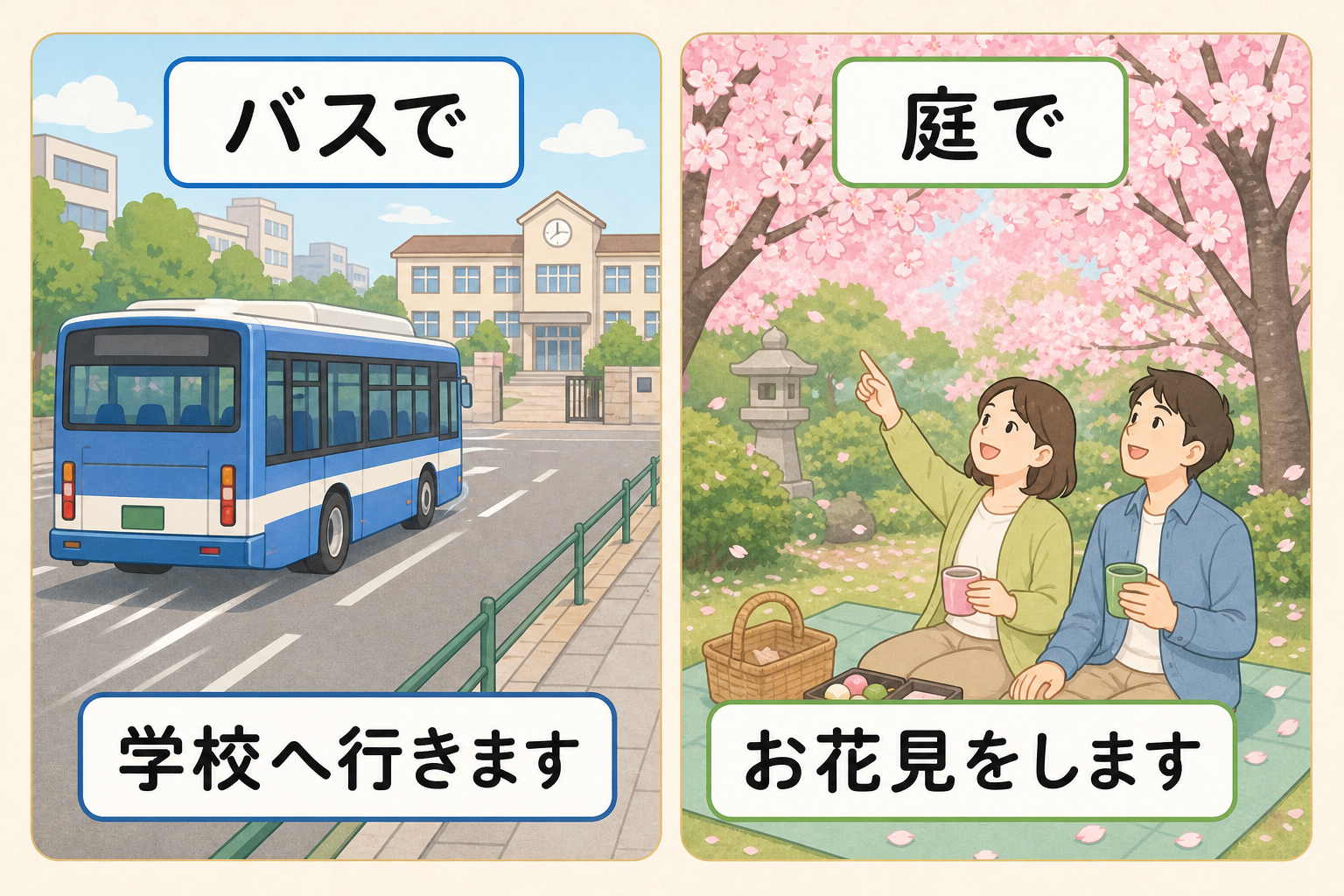
- Compare it with Lesson 5: バスで学校へ行きます uses で for the means of travel, while 庭でお花見をします uses で for the place of an activity.
- Do not use で with a destination followed by 行きます. Use へ for a destination: 学校へ行きます。
Vませんか
Description
Use the polite negative question form Vませんか to make a friendly invitation. In this pattern, it means “Would you like to …?”
Examples
Swipe left or right to view all columns
Usage Notes
- Vませんか is a gentle way to invite someone. It does not pressure them to say yes.
- A friendly response can be いいですね (“That sounds nice”) or はい、〜ましょう (“Yes, let’s …”).
Vましょう
Description
Use Vましょう to suggest doing something together, or to accept an invitation positively. It means “Let’s …”.
Examples
Swipe left or right to view all columns
Usage Notes
- Use Vませんか when you are opening an invitation; use Vましょう when making a shared proposal or accepting one.
- The verb stays in its polite stem form before ましょう: 行きます → 行きましょう.
〜か in a Response
Description
You learned か as a question marker in Lesson 1. In a response, it can also show that you have just received or recognized new information. The tone is usually rising or surprised, but gentle.
Examples
Swipe left or right to view all columns
Usage Notes
- Here, か responds to information you have just heard. It is not asking for a full answer in the same way as 何をしますか。
- そうですか is a useful response when you have understood new information.
Practical Conversation: A Friendly Invitation
This is an original conversation. Practise it, then change お茶, 3時, or the activity to make your own invitation.
Swipe left or right to view all columns