Grammar Notes: Lesson 5
Destinations, Transportation, and Travel Companions
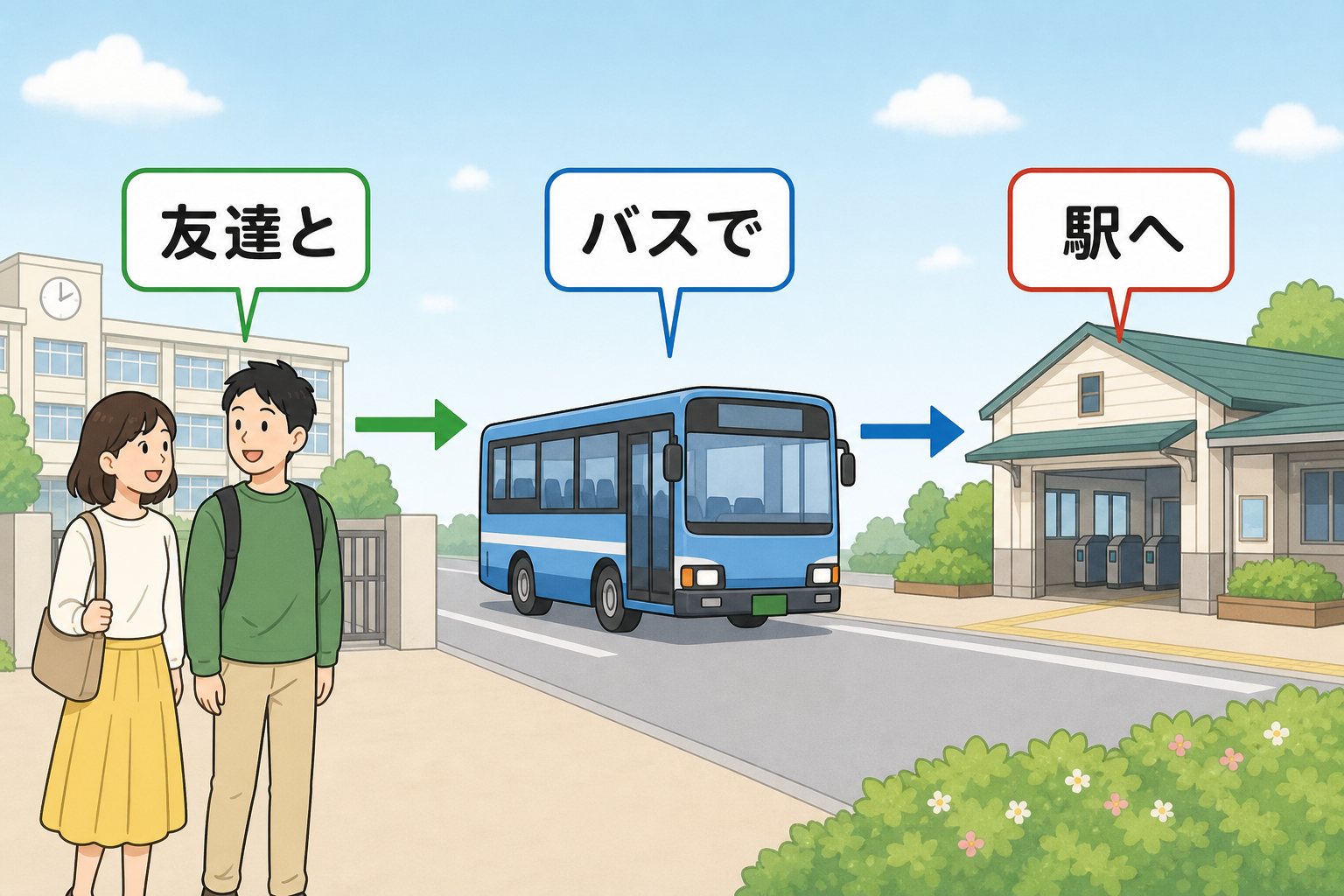
This lesson builds on the polite verb forms from Lesson 4. You will learn to describe a trip with a destination, a means of transportation, a companion, and a time.
Before You Start: Date Questions
Description
This lesson uses question words for dates, but you do not need to learn full calendar-date readings yet. Learn these complete question forms first.
Swipe left or right to view all columns
Examples
Swipe left or right to view all columns
Usage Notes
- Learn 何月 and 何日 as complete question expressions.
- This lesson does not introduce specific calendar dates such as 3月5日. Those readings need a later, dedicated date lesson.
[Place] へ 行きます / 来ます / 帰ります
Description
Use へ after a destination with 行きます (go), 来ます (come), or 帰ります (go home; return). Although it is written へ, the particle is pronounced e.
Examples
Swipe left or right to view all columns
Usage Notes
- 行きます describes movement away from the speaker; 来ます describes movement toward the speaker or the place of the conversation.
- 帰ります means returning home or returning to a familiar base.
どこ[へ]も 行きません / 行きませんでした
Description
Use どこも with a negative form of 行きます to say that you do not go anywhere. You may include へ before も, or omit it.
Examples
Swipe left or right to view all columns
Usage Notes
- Use this pattern with a negative verb: 行きません or 行きませんでした.
- Both どこへも and どこも are natural in this pattern.
[Vehicle] で 行きます / 来ます / 帰ります
Description
Use で after a vehicle to show the means of transportation.
Examples
Swipe left or right to view all columns
Usage Notes
- 何で asks which means of transportation someone uses.
- 歩いて already means “on foot,” so do not add で after it.
[Person] と Vます / ひとりで Vます
Description
Use と after a person or animal to say who does an action with you. Use ひとりで when you do it alone.
Examples
Swipe left or right to view all columns
Usage Notes
- と means “with” here; it has a different role from the “and” use learned in Lesson 4.
- Do not use と with ひとりで.
いつ
Description
いつ means “when.” Use it to ask about the time, day, week, month, or date of an action when the exact time is not known.
Examples
Swipe left or right to view all columns
Usage Notes
- A relative time word such as 来週 does not need に, following the time rule from Lesson 4.
- Use いつ when the answer could be any time, rather than only a clock time.
Sentence よ
Description
Add よ to the end of a sentence when you are giving the listener new information or making sure they notice it.
Examples
Swipe left or right to view all columns
Usage Notes
- よ can sound helpful when you are giving useful information.
- It is different from ね, which invites agreement or confirmation.
そうですね
Description
そうですね can show that you agree, are considering a question, or are gently acknowledging information.
Examples
Swipe left or right to view all columns
Usage Notes
- The tone and context tell the listener whether そうですね shows agreement or a moment of thought.
- It is a natural response, not a replacement for a complete answer when more information is needed.
Practical Conversation: Finding the Right Bus
This is an original conversation. Practise it, then replace バス, 駅, and the transportation words with vocabulary from this lesson.
Swipe left or right to view all columns